Marinduque, Heart of the Philippines and My Island Paradise,Here We Come!
Marinduque Mainland from Tres Reyes Islands
View of Marinduque Mainland from Tres Reyes Islands-Click on photo to link to Chateau Du Mer
WELCOME TO MY SITE AND HAVE A GOOD DAY
If this is your first time in this site, welcome. It has been my dream that my province, Marinduque, Philippines becomes a world tourist destination not only during Easter Week but also whole year round. You can help me achieve my dream by telling your friends about this site. The photo above is your own private beach at The Chateau Du Mer Beach Resort. The sand is not as white as Boracay, but it is only a few steps from your front yard and away from the mayhem and crowds of Boracay. I have posted some of my favorite Filipino and American dishes and recipes on this site also. Some of the photos and videos on this site, I do not own. However, I have no intention on infringement of your copyrights. Cheers!
I am not talking about the Oscar nominated movie with a similar
title(Photo above). Have you seen this award-winning movie?
This article is about several names that I have been
called and addressed, depending on who is addressing me. I arranged it
from the most formal and to the least formal as follows:
1. Dr Katague: From My former professional peers in FDA, clients and
regulatory officers from Pharmaceutical Companies all over the world
2. Sir David Katague or Sir David: From My former students from the
University of the Philippines from 1956 to 1959. From Younger
Readers/Followers of my blogs
3. Mr. Katague: From people I just meet in social functions and that I am not well acquainted with
4. David or Dave: Almost from all my friends, neighbors and distant relatives and most of my FaceBook friends
5. Kuya or Manong Dave or Uncle Dave: From closed relatives on both Macrine's and my side of the family
and lastly
6. Nonoy, Noy, or Nonoy Dave or Tito Nonoy : From my closed relatives from Iloilo, Philippines
My closed relatives-who call me Dad, Lolo, and Kuya or Uncle Dave.
Note: In some rare cases, I have been called other names, such as Hey
you!, Husband of Macrine or Husband of the Patient, Father of Ditas
etc... I have been called GrandPa or Lolo of CarennaKT for several years
now. Will I still be alive when a great grand child call me Grand-Grand
Papa or LOLO?
Incidentally, when I was a graduate student in Chicago in the
mid-1960's, a stranger once called me a Coconut, and a Chinese
immigrant.
Here's a list of ethnic slurs referring to Filipino-Americans. Not in
this list is coconuts-brown outside but white inside-refers to second or
third generations Filipino-Americans who acts just like a normal white
Caucasian Americans but with Filipino skin and physical features.
Here are some Derogatory terms referring to the Philippines and Filipinos from Wikipedia
There are a variety of derogatory terms referring to the Philippines and Filipinos. Many of these terms are viewed as racist.
However, these terms do not necessarily refer to Filipinos as a whole;
they can also refer to specific policies, or specific time periods in
history.
Chinese
Huan-a (Chinese: 番仔; Pe̍h-ōe-jī: hoan-á) – a pejorative term in the Hokkien
or Minnan languages literally meaning "foreigner or non-Chinese". Used
by ethnic Chinese from Taiwan and other parts of South East Asia to
refer generally to non-Chinese Southeast Asians and Taiwanese Aborigines. In the Philippines, this term is used by Chinese Filipinos to refer to those of Filipino descent.
English
Gugus (also spelt Goo-goos) – a racial term used to refer to Filipino guerillas during the Philippine–American War. The term came from gugo, the Tagalog name for Entada phaseoloides or the St. Thomas bean, the bark of which was used by Filipinas to shampoo their hair. The term was a predecessor to the term gook, a racial term used to refer to all Asians.
Flip – used to refer to American-born Filipinos.
The term has vague origins with many hypotheses regarding its origin.
It is suggested that the term originates from the World War II era. The
term was allegedly an acronym for "fucking little island people" causing
some Filipinos to avoid referring to themselves by this term. However,
the term is also being reclaimed by some by changing the alleged
originally meaning of the word to "fine looking island people". Some are
convinced that the term is just a short version of the term "Filipino".
Malay
Pilak – literally meaning 'silver' or 'money' in Tausug language used pejoratively by Sabahans to refer to illegal immigrants from ARMM of the Philippines.
Spanish
Indio – literally, "Indian". The term was used to refer to native Filipinos during the Spanish colonization of the Philippines,
and developed negative connotations due to the mistreatment of people
with the label. "Filipino" was meanwhile originally reserved to Spanish
persons living in the archipelago.
Ditas and Me and Former Governor Arnold S- Ditas former old Boss, 2006
This
is my response to the query on my three most widely read articles from
my Hubpages Writing Account for StoryWorth. As of this writing date here
are the 3 articles with their Number of Page Views( Readers) and
Comments: In this article, I will published only excerpts from #2.
Excerpts from #1 and #3 will be in two separate articles.
1. My Bucket List -101 Things to Do before I Die, 9,701 page views and 10 comments.
2. Caste System and Discrimination in the Philippines -7,730 page views and 31 comments
3. Encounters with Aswangs, Nono's, and Ghost in the Philippines-5,207 page views and 20 comments
I
had stopped writing new articles for Hubpages two years ago. As of
today, I have 25 articles with a total page views of 31,584 and 182
readers' comments.
Here's
an Excerpts from my most commented article -Caste System in the
Philippines-Discrimination of Filipinos in the United States and my
Pinoy Pride List
Caste System in the Philippines
There
is a caste system between the poor and the rich and the educated and
non educated Filipinos. The Overseas Filipino Workers( OFW's) are
considered the modern economic heroes of the Philippines. Their
remittances help uplift the economic woes of the country. Will the OFW's
be another caste group of the future in the Philippines?
In this hub/article, I have also listed 20 Filipino and Filipino-Americans in my Pride List.
Is there a Caste System in the Philippines?
The
Philippines is not India or Pakistan. But better believe it, there is a
caste system in the Philippines. The caste system exits between the
rich and the poor, between educated and uneducated, and to a lesser
extent between the Filipino-mestizos and the “browned-skinned and
flat-nosed” Filipinos.
Let me start with the clash between the
rich and the poor. It is well known that the Philippines is not really a
true democracy but an oligarchy. Oligarchy is defined by Webster as a
form of government in which the supreme power is in the hands of a small
exclusive class. This exclusive group are the rich. If you live in the
Philippines, you know or have heard of a few families that run our
country as well as our business. And what about the poor? They just
suffer and accept what is handed to them, good or bad!
The
second item is the clash between the educated and uneducated. The
educated usually had comfortable lives, excellent social status,
travels, eat in five-star restaurants and also send their children to
excellent schools. The uneducated have lower social status, do the
menial jobs and if lucky can get jobs as farming tenants, personal
maids, or drivers of the rich and educated Filipinos. In Marinduque,
there are hundreds of tenants who work for the rich landowners. These
folks were raised as Roman Catholics, but only go to Church twice a
year, during Christmas and Easter. When invited to your house in town,
they will not enter your front door. They enter the back door. Entering
the front door is bad manners. They will not eat at the same time with
you, even though you invite them. They will wait until you are finished
before they eat.
On the last item of heritage, Spanish mestizos
versus brown skinned Filipinos. Today, this is not so blatant. But
during my grandparents and parents time, the mestizos feel they are
superior in terms of social standing and race. My grandparents speak
fluent Spanish as well as local dialect (Tagalog or Ilonggo) and are the
elites of society. The mestizos would look down on the non-mestizos or
even the Chinese Filipinos. In Marinduque, a few decades ago, if you
were Filipino-Chinese, you would not be invited or included in the
social activities of the “socialites”, even though you are doing well as
a businessman. It is only today that it is no longer a social taboo to
invite the non-mestizos to your home for socializing. During my
grandparents' time, it was also a taboo to marry outside your social
class. Children of the rich are discouraged to associate with children
of families that reside on the “other side of the river” (similar to
American expression of the “other side of the railroad track”).
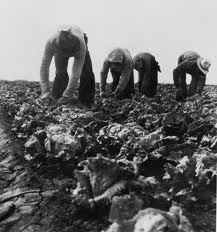
Discrimination of Filipinos in US in the 1930's
Filipinos Working in the Farms of Central California in the 1930's
Filipino Discrimination in the US in the 1930s and 1960s
The
prejudice against Filipino immigrants in the US and specially in
California in the 1920s to 1940s is well documented. One of the
well-known books, America is in the Heart, documenting the life of the
Filipino immigrants at that time period, was written by Carlos Bulosan.
Mr Bulosan is my number one literary heroes of that time.
Like
many Filipinos during that time, Bulosan left for America in July 1930
at age 17, in the hope of finding salvation from the economic depression
of his home. He never again saw his Philippine homeland. No sooner had
he arrived in Seattle, was he immediately met with the hostility of
racism, forcing him to work in low paying jobs.
He worked as a
farm worker, harvesting grapes, asparagus and other kinds of hard labor
work in the fields of California. He also worked as a dishwasher with
his brother, Lorenzo in the famous Madonna Inn in San Luis Obispo. He
was active in labor politics along the Pacific coast of the United
States and edited the 1952 Yearbook for ILWU Local 37, a predominantly
Filipino American cannery union based in Seattle.
Mr
Bulosan died in 1956. To honor his memory, a Bulusan Memorial Exhibit
located in Seattle's International District and in the Eastern Hotel
features his literary works and manuscripts. One of his famous books,
America is in the Heart based on his autobiography is now made into a
Philippine movie.
One of the famous quotes from that book is
timeless, as follows: "We in America understand the many imperfections
of democracy and the malignant disease corroding its very heart. We must
be united in the effort to make an America in which our people can find
happiness. It is a great wrong that anyone in America, whether he be
brown or white, should be illiterate or hungry or miserable."
References
(1) Carlos Bulosan, America Is in the Heart, 1946
(2) The Delano Manongs:Forgotten Heroes of the United Farm Workers-a Video by mediafactory.tv/2008/01
My top 20 Filipino American Pride List
I
have always wanted to publish my own Filipino-American Pride List. The
20 names (BOTH LIVING AND DEAD) below are not listed in order of
importance. This is my personal list and you are welcome to suggest any
names that could be added in this list. My only requirement is that they
have excelled in their field of expertise ( entertainment, sports,
science, medicine, literature, arts, law and politics). I have
personally meet Olivera, Comiso, Cabaldon, Pasquil, and Nicolas-Lewis.
Cabaldon and Pasquil are associates and friends of my daughter, Ditas
Katague ( Number 8). And last but not least, Number 14 in this list is
my oldest son, Dodie Katague, Writer and Lawyer. Pure Filipinos like
Manny Pacquiao, Dr Fe Del Mundo, Lea Salonga or Charice Pempengco are
not included in this list. They belong to the Filipino Pride list.
1.
Baldomero Olivera, Ph.D. – Distinguished Professor of Biology,
University of Utah in Salt Lake City, Utah; first Fil-Am member of the
United States National Academy of Science. Research: neurotoxins from
venoms of predatory cone snails
2. Emil Guillermo – award winning
journalist, writer, and broadcaster. First Filipino American to anchor a
regularly scheduled national news program, NPR "All Things Considered,"
May 1989. Winner of American Book Award, 2000.
3. Jose Antonio
Vargas – 2008 Pulitzer Prize Winner in Journalism for his work with the
Washington Post; DREAM Act advocate; "illegal alien"
4. Carlos Bulosan – Author, America Is in the Heart. Discrimination of Filipinos in the 1930s.
5.Loida
Nicolas-Lewis – Chairman and CEO, TLC Beatrice International Holdings,
Inc. Active on Filipino American politics and policy
6. Cristeta Comerford – First woman executive chef at the White House.
7. Josefino Comiso, Ph.D. – physics expert at NASA. My contemporary at PAASE, Research on arctic melt and global warming
My Youngest Daughter Ditas in Purple! July, 2021
8.Ditas
Katague was appointed by Governor Brown in March 2011 as Commissioner
Sandoval’s Chief of Staff, California Public Utilities Commission. Ditas
has more than 20 years of experience at federal, state and local
government agencies as well as in private and non-profit sectors. Prior
to coming to the CPUC, Ditas was Chief Deputy Commissioner of the
Department of Corporations. She also served in the Governor’s Office of
Planning and Research as Director of Census 2010-2020 and is an expert in
civic engagement and public participation. She was also Assistant
Secretary for Transportation at the California Business, Transportation
and Housing Agency. Ditas has a B.A. in Social Sciences and Practice of
Art (double major) from the University of California, Berkeley, and a
Masters in Public Administration (Intergovernmental Management and
Organization Development) from the University of Southern California.
Ditas was just recently appointed as a member of the US Census Bureau
Advisory Board for Racial, Ethnic and Other Populations. Ditas is my
youngest daughter.
9.
Eleanor Mariano – Rear Admiral (Lower Half), U.S. Navy, retired. First
Filipino American to be promoted to a flag officer rank; former White
House physician
10. Mona Pasquil Rogers- in November 2009, became
the first woman to serve as acting lieutenant governor of California,
Friend and associate of my daughter, Ditas
11. Steve Austria - Republican congressman from Beavercreek, Ohio.
12.
Rozita Villanueva Lee – daughter of Eugenio Villanueva, who emigrated
from Pangasinan to Hawaii as part of the recruited labor force for the
Hawaii plantations, has been described as one of the top ten successful
Filipinos abroad. She has served as National Vice Chair of the National
Federation of Filipino American Associations and in a number of other
prominent positions of responsibility. On September 16, 2010, the White
House announced her appointment as a member of the President's Advisory
Commission on Asian Americans and Pacific Islanders.
13.
Christopher Cabaldon – Mayor of West Sacramento, California, born in
1965. Openly gay activist. Have attended fun raising activities for his
political activities.
Dodie ( my oldest son)- BS in Geography Graduation at UC Berkeley, 1980
14. Dodie Diosdado Katague- author of Cloyne
Court and Prosecuting Attorney,Contra Costa, California. Here's a
summary of his first novel Cloyne Court" In 1946, the "real" all male
"Animal House" was born when Cloyne Court become a student co-op. But
the real story begins when Cloyne Court went co-ed in 1972 with the
arrival of sixty-two women. Katague's sexy, reveal-all memoir takes
place in the late 70s, soon after the women moved in. All it takes is
one kiss to transform animals into horny princes.
15. Enrique Iglesias – a Spanish pop music singer-songwriter. Is now mainstream US singer
16.
Christine Gambito – an American Internet personality, actress, and
comedian; she maintains one of the most-subscribed-to channels on
YouTube. Also appointed Ambassador of Philippine tourism
17. Tani
Gorre Cantil-Sakauye was born on October 19, 1959). She is a
Filipino-American jurist, and is the 28th Chief Justice of California.
She was nominated by Governor Arnold Schwarzenegger for California's
highest judicial office on July 22, 2010, and retained in office by
California voters on November 2, 2010, and was sworn in on January 3,
2011. Her Hawaiian-born father, Clarence, was of Filipino and Portuguese
ancestry, while her mother, Mary Gorre, was Filipino. She was a
classmate of my oldest son ( Dodie) in Law School at UC Davis.
18.
Alex S. Fabros, Jr. – Historian, professor, retired U.S. Army officer;
Documentaries: “Filipino Americans: Discovering their Past for the
Future”, "Unsung Heroes"; historian, "Filipinas Magazine"; Historian and
Guest Curator, National Steinbeck Center's "Filipino Voices: Past and
Present."; and winner of New American Media's "Ethnic Pulitzer Prize".
19. Cheryl Burke- Professional Dancer, Trophy Winner-ABC Dancing with the Stars
Fifteen
guests arrived to celebrate Macrine's Waksi. We lighted two candles to
honor her memory. The guests partake both Pinoy and American Dishes.
Igsoon Ceding and her two children(Albert and Christine) brought a dozen
tangerine roses. For Pinoy dishes we had adobo sa gata ( gift from
Merlet), beef calderetta steamed rice, and Pancit. For American Dishes
we had Honey Baked Ham, cranberry, Chicken Macaroni salad, salad greens
with artichoke hearts/pepperoni and Hawaiian sweet rolls. For dessert we
had rice cakes, brown and white puto and peach pies. We had soft drinks
and beer. Here are some photos of the ocassion.
Igsoon Ceding with the Dozen Tangerine Roses for the occasion
Igsoon Ceding and son, Albert and daughter, Christine from San Jose, CA
Yuka Maeda Chilan- the only relative of Macrine to attend
Yuka's Mother and Father in Law Visiting from Equador
Alix, Brendan and Ditas playing cards ( Pikwa)
The
kids ( Dodie and Ditas),and grand kids(Alix and Carenna), Yuka and
Brendan ( Alix boyfriend) playing Pikwa after getting tired with mahjong
Thank you all for coming to celebrate Macrine's Waksi.
Special thanks to Merlet for the Adobo sa Gata. Now I can rest for a few
days-heal my aching knees and tired body.
Meanwhile enjoy the latest of my pineapple.
My Pineapple in the Front Porch-getting bigger everyday
Exactly one year from the day of the death, a final mourning called
‘Waksi’ is celebrated in the Philippines. In a Waksi, the family prepares a feast and,
together with the visitors, offers prayers to the deceased. Some
provinces consider this as the day where the family can go back to
wearing colored clothes.
This
coming Sunday (August 8), I am preparing a simple lunch ( Honey Baked
Ham- Chicken Macaroni Salad, Pancit and some other Pinoy Dishes to
celebrate the first anniversary of Macrine's death. I invited Macrine's
sisters, nieces and other relatives, but none will be attending. So, as
of today, I have only 10 guests coming, all fully vaccinated but will
still wear their masks for safety and precautionary measures due to the
surging Covid-19 Delta variant.
I am just planning on
lighting a candle to honor Macrine and her Memories. Speaking of
Memories, may I have the pleasure of reposting Macrine's short
biography.
Macrine passed away last August 10, 2020. She had lived a good life
for she had touched many other lives through her community involvement
here in the US as well as in the Philippines.
This post is
to remember Macrine(RIP) in her community involvement during her
productive and well-lived life here in the US as well as in the
Philippines.
The
three awards are Macrine's involvement with Marinduque International,
Inc and the Marinduque Association of the Capital Area. For details read:
Macrine was actively involved with Filipino-American
community in the tri-state area of Maryland, Virginia and Washington,
DC. SHE was also active with the Marinduquenos of the Capital Area (MACA).
Some of MACA's projects were giving scholarships to needy students in
PI. We also collaborated with the humanitarian projects of “ Feed the
Hungry, Inc”in Marinduque. In 1998, we participated in the medical
mission to Marinduque. We donated 100 used eyeglasses, medical supplies
and equipments to the local hospital. In May, 2001 we again participated
in the medical mission sponsored by Marinduque International,Inc.. I
helped in the distribution of drugs and served as acting treasurer
during the mission week, while Macrine was Executive Director of the
organization.
Macrine short biography was published in MI, Inc
Newsletter when she was elected President in 2003 as follows. "Macrine
was born in Boac and a product of the Immaculate Conception Academy High
School. She obtained her Bachelor in Business Administration degree in
1957 from the University of Santo Tomas. Two month after graduation she
married her college sweetheart, David Katague from Iloilo, who was then
teaching chemistry at UP Diliman. They immigrated to the US in 1960.
Macrine
stayed home for 18 years raising her four children but decided to go
back to nursing school in California. In 1979, she received her Bachelor
of Science degree from Holy Name College in Oakland, CA. as well as a
Certificate in Public Health Nursing specializing with Spanish speaking
patients.
Macrine Receiving PAFC Award and Plaque, June 1999
In 1990, Macrine and David moved to Maryland where
she worked for nine years as Quality Improvement Nurse Manager for several home
health organizations in the Washington, DC area. It was then, when she
joined the Marinduqueno Association of the Capital Area (MACA) and
became an active member of the association. She retired in 1998 and got
involved with the Filipino-American organizations in the DC
metropolitan area".
In June, 1999, Macrine was elected overall
chairperson of the Festival Committee that was in charge of the
celebration of Philippines Independence for the whole month of June. An
article was published by the Manila Mail, dated June 15, 1999. An
excerpt of the news article written by Bing C. Branigin reads:
RP TAKES CENTER STAGE-45 GROUPS JOIN PARADE IN D.C.
“A
big crowd watched the Philippines took center stage when
Filipino-Americans stage a colorful parade, fair and cultural show along
historic Pennsylvania Avenue on June 6.
Filipino Americans
display their pride in their culture and heritage to mark the 101st
anniversary of independence from Spain and more than a century of
Philippines- American relations. More
than 45 Filipino- American organizations participated in the parade and
whole day fair and cultural shows. They are groups from Washington,
D.C., Maryland, Northern Virginia, South Carolina and the 40 strong
Ati-atihan group from Virginia Beach. The Marinduquenos who are this year hosts, showed their Moriones, clad in colorful costumes and mask.
Macrine
Katague, Philippine Festival chairperson, said she was really impressed
by the number of groups who participated. For the last six months, the
Philippine Committee had been meeting regularly to make this year's
event better.
A group of twenty food vendors sold favorite
Philippine dishes, like lechon, pancit etc...For drinks, there was San
Miguel beer, sago at gulaman, coconut juice and halo-halo. There were
also twenty tents filled with dry goods, like T-shirts, jewelry, gift
items, travel agencies and phone cards. One of the highlights of the
fair was on-the-spot painting contest for the kids. The Philippine
Embassy displayed stamp collection, fabrics and handicraft from the
Philippines
Ambassador and Mrs Raul Rabe,
patiently stayed at the Fair from 9:00AM to 6:00PM, enjoying all the
activities. Rabe will end his term the end of this month. He will be
replaced by Ambassador Ernesto Maceda.
Mr.
Rabe told Manila Mail “ This is a great thing that we are celebrating
our independence here in Pennsylvania Avenue. I noticed that every year
we are getting better and bigger,. Hopefully we will keep the momentum
going”..
To show their support to their “kababayans”,
Marinduquenos from New Jersey came to town. Al Molato who represented
the Eastern Seaboard Marinduqueno said, “ This is fantastic, imagine our
small island is so small and taking a big role in the capital to host a
big endeavor like this. I would like to salute my co-marinduquenos and
Macrine Katague the chairperson, for a wonderful job.”
Meanwhile,
enjoy this photo of Macrine during our trip to London at Wembley
Stadium watching the Football Game between the Redskins and 49'ers.
I am re posting today, excerpts from my article "The highlights of my Professional Career in Chemistry" for my StoryWorth account.
My picture used by Stauffer Chemicals in their Advertisement Brochures, 1981
In my more than 40 years of professional career, I have experienced both
working rank and file, as well as supervising the work of subordinates.
I have worked in four private firms and the Federal Government, the
Food and Drug Administration (FDA), where I retired. I enjoyed the
challenges and difficulties of both types of job situations. This is
the highlights of my work experiences.
My first job after completing my doctorate degree was a Chemist for Chemagro Corporation
in Kansas City, Missouri. It was a subsidiary of Bayer Corporation, a
German conglomerate. I worked for the analytical chemistry department
comprised of about fifty people; half that number was either chemists or
biologists. My specific task was to develop analytical methods for the
detection of pesticide residues in plant and animal tissues. I worked on
my own, similar to six other bench chemists, and we all reported to the
same supervisor. My
Photo with my two Colleagues and a Socialite for Company Press Release
was published in the KC Star newspaper to improve company image to the
public,1965.
The firm sponsored my visa conversion from a student to a permanent
resident, and I was able to legally work and reside in the United States
with my family. The company generously took care of its employees. At
the end of each successful year, everyone received a 13th month salary
bonus. The employees and their families celebrated wonderful annual
Christmas parties in a downtown Kansas City hotel, with dancing and free
drinks for the whole night.
As much as I enjoyed and loved working for Chemagro for five years, I
found a new job which offered a substantially higher pay. Due to my
exemplary work performance, my supervisor lobbied for me to stay with
the company. I had to turn him down because they could not match the
package presented by my new employer. It was also a chance for me and my
family to move and live in the US west coast, where the mild winter
climate is bearable compared to the Midwest.
My next job was at the agricultural research division of Shell Development Company
in Modesto, California. I was a Research Chemist, and again I worked
individually, same as five other chemists who all reported to a
supervisor. My specific duty was similar to my previous job. I worked
for them for five years, until the company decided to get out of the
pesticide business. They closed their research facility affecting the
jobs of more than 200 employees.
Macrine and I during one of the Stauffers Company Party for Employees, 1982
My third industrial job was with the agricultural research division of Stauffer Chemical Company,
located in Richmond, California. I was a Senior Research Chemist doing
the same project as my two previous jobs. I worked for twelve continuous
years for the company, with outstanding annual job performance. I
became a Principal Research Chemist, the highest attainable
non-supervisory position.
One day in 1986, my supervisor informed me that my job had been
eliminated, and I had one day to vacate the facility. It was the most
dreadful lay off experience in my life. I felt anger, sadness and
humiliation to be dismissed from work with one day notice, after all the
years of hard work invested for the company. This was an unforgettable
incident and was the gloomiest point in my professional career.
One of the chemists was distressed and expressed his outrageous anger by
threatening the company and its workers. He told his supervisor of his
intention to bomb and burn down the laboratory. He was immediately
escorted by the security staff out of the building and into his car. He
was informed to leave behind his personal belongings; they will be
mailed to his residence. He was warned never to show up again near the
company premises or risk getting arrested.
My supervisor was kind and allowed me to take my time to pack up my
belongings. It took me two days to clear up my workplace. I was provided
clerical help and office space, in preparation to look for another job,
such as updating resumes, and using the computer and copy machine. I
did received six weeks of separation pay plus benefits. Losing my job with Stauffer, inspired and motivated Macrine to go
back to school and earned her Bachelor's Degree in Nursing. This was to
insure that the next time I lost my job, she will be ready to support
the family and we do not have to go back to the Philippines.
Fortunately, with the help of a friend who is a Church parishioner, I
found another job thirty days after leaving Stauffer Chemical Company.
He hired me as a senior research chemist and as a group leader with two
technicians to supervise. It was in the same field as my expertise in my
previous three jobs spanning the last twenty one years. My new employer
was Chevron Chemical Company, and which was located in the same city as my former employer.
This job gave me the introduction and basic knowledge of managing the
work of subordinates. I worked for Chevron Company for four and a half
years. The company decided to consolidate their research facilities in
Texas, and lay off all its research employees. This time I had enough
distress and agony from working, and eventually getting laid off from
several private companies. To avoid going through any more miserable
layoffs, I made a vow that I would never again work for a private
company.
In the three private companies I worked for, I was able to publish
scientific journals for some of the research studies and analytical
methods which I developed for the respective companies of Chemagro,
Shell Development and Stauffer.
After deciding and making a vow to avoid working in the private sector, I
made my new goal which was either to work for the state of California,
or the Federal government in Washington, D.C. Four months after I lost
my job in Chevron, I was lucky and joyful to be hired by the Food and Drug Administration as a review chemist in the fall of 1990.
In 1994 I was promoted as an Expert Research Chemist with a GS-14
rating. My expertise was on Anti-malarial and Anti-parasitic drug
products. In 1997, I was again promoted to Chemistry team leader,
supervising the work of six Chemistry reviewers including five with
doctorate degrees.
As team leader, I was responsible for prioritizing, assigning, and
assuring the technical accuracy of all chemistry, manufacturing and
control issues for all new drug applications submitted to the Division
of Anti-Infective Drug Products, Center of New Drugs.
In 1998, I won the Equal Employment Opportunity (EEO) Award. The
citation reads, “For outstanding accomplishments in fostering the
objectives of the EEO Program by hiring minorities and encouraging their
professional growth while providing excellent leadership.” I have
received numerous certificates of appreciation, awards in leadership and
communications, commendation for teamwork and excellence in the
accomplishment of the FDA mission. I have also received several letters
of appreciation from private industry for my review work.
Managing the work of others has its challenges. Moreover, it develops
one’s skill in handling and developing people, and the compensation
rewards and benefits are better. Due to additional duties,
responsibilities and leadership, supervisory work can be more stressful
than working as a subordinate. However, supervisory jobs give one more
personal growth and satisfaction, based on my personal experience. My
work in FDA as a team leader managing the work of six scientists had
been the happiest and rewarding work experience in my career in
Chemistry.
Meanwhile, enjoy this video of Sulic performance of Bohemian Rhapsody
So what is my formula for success? You need to work hard,practice patience and most of all LUCK!
This my response to the query on my three favorite awards for the StoryWorth Book of Memories.
I
have several awards and certificates of Appreciation from the FDA but
the following three are my most treasured plaques and awards: (1)Equal Employment Opportunity (EEO) Award, (2) Parangal 98 Award in Chemistry and
(3)Special Recognition Award for my Contribution to ease suffering of burnt
victims of the September 11, 2001 bombing of the World Trade Center in New York
and the Pentagon in Washington, DC.
This award-Equal Employment Opportunity (EEO) was my most treasured award. The following are the reasons of my getting the award. Today, Dr Janet Woodcock is the Acting FDA Commissioner. It is in her reign that the Covid-19 vaccines gets its Final Approval.
Special Award for My Contribution to the September 11, 2001 Bombing of the World Trade Center and the Pentagon
The summary of my Pamana Award in Chemistry nomination package reads:
"Dr Katague is a trailblazer in the field of Chemistry and Drug Regulation. He is the first Filipino American to attain the position of Team Leader and Expert
in the Center of New Drugs, Food and Drug Administration. He is also
the first Filipino-American to be elected for two 5 year terms(
1995-2005) to the United States Pharmacopeia Council of Experts since
its inception in 1820. Dr Katague's drive and energy to succeed is a
representation of the Filipino people's talent and passion for
excellence. He has shown that Filipinos can contribute significantly to
the advancement of science, therefore help the world a better and safer
place by insuring that only safe and better quality drugs are approved
and marketed."
The following is an excerpt from the article published in Sulo Newsletter, Vol.8, No.1 dated January 7, 2003. Sulo is the official newsletter of PAASE ( Philippine-American Academy of Science & Engineering). I have been a member of PAASE since 1969.
"David is the oldest of seven children of Dr. and Mrs. David Jamili
Katague, Sr of Barotac Viejo, Iloilo. Even before he went to grade
school, he had dreams of coming to US, since he had a lot of contact
with American GI who were dental patients of his father in the
US-Filipino army during World War II. In 1951, he graduated
valedictorian of his high school class.
He enrolled at the University of the Philippines Iloilo College (UPIC)
in Iloilo City. During his two years at UPIC, he was a recipient of
several scholarships, such as the Fernando Lopez,university and college
scholarships. In 1955, he graduated with a Bachelor's degree in
Chemistry in UP Diliman, Q.C. at top 1% of his class. The next year, he
passed the board examination for Chemists coping 3rd place nationwide.
He was appointed instructor in Chemistry and taught chemistry for three
years in his Alma Mater before pursuing graduate degrees to the US. In
1957, he married Macrine Nieva Jambalos(RIP) of Boac, Marinduque. In 1962 he
obtained his Master of Science degree followed by his PhD.in
Pharmaceutical Chemistry at the University of Illinois in Chicago in 1964.
The following are my other Awards, Professional Activities and Scientific Publications:
A.OTHER AWARDS AND RECOGNITONS:
1. Initiated to Rho Chi Phi, Pharmaceutical Honor Society, 1962
2. Elected to Sigma Xi, Scientific Research Honor Society, 1964
3. Listed in 12th Edition, American Men and Women of Science, 1972 (page 3184)
4, Listed in Who's Who in the West, 15th & 21st Editions, 1976 & 1987
5. Listed in Who's Who in Technology Today, 2nd Edition, 1981 (page 999)
6. Listed in Experts and Consultants, Chemistry Section,1982 (page 515)
7. Group Recognition Award, Halofantrine Review Team, FDA, May 1993
8. Team Excellence Award for Albendazole Review, FDA May, 1997
9. Commendable Service Award on Botanical Guidance, May, 1997
10. Commendable Service Award on Guidance in Evaluation of Clinical Studies for Antimicrobial Drug Products, May, 1998
11. Team Excellence Award for Trovafloxacin/Alatrofloxacin Review, May, 1998
B: OTHER PROFESSIONAL ACTIVITIES:
1. Guest Lecturer, Institute of Natural Sciences, U. of the Philippines,
January 1986 'sponsored by TOKTEN and United Nations Development
Program, New York
2. President, U. of the Philippines Alumni Association, Berkeley Chapter,Berkeley, CA 1988-1990
3. Elected to the USP Committee on Revision,Standard Division,1995-2000 and 2000-2005
Antibiotics and Natural Products Subcommittees
4. Member, Philippine American Academy of Science & Engineering (PAASE)since 1969
C: SCIENTIFIC PUBLICATIONS:
1. Analysis of the Volatile Components of Ylang-Ylang Oil by Gas Chromatography.
J. of Pharmaceutical Sciences, 52 252(1963)
2. Gas and Thin Layer Chromatographic Analysis of the Volatile
Components of Papaya Fruit, J. of Pharmaceutical Sciences, 54 891 (1965)
3. Determination of Fenthion Residues in Plant and Animal Tissues by
Electron-Capture Gas Chromatography, J. of Agri & Food Chemistry,
Vol 14, No.6 (1966)
4. A Gas Chromatographic Method for the Determination of Bayer 37289,
its Oxygen Analog and 2,4,5-trichlorophenol in Crops, J. of Agri &
Food Chemistry, Vol 14, No.5 (1966)
5. Metabolism of P32 Labeled Dasanit in Cotton Plants, Bulletin of Environmental Contamination & Toxicology, Vol 2 (1967)
6. Gas Chromatographic Method for Residues of Baygon and Metabolites in
Plant Tissues. J. of Agri & Food Chemistry, Vol 20, No.6 ( 1972)
7. Characterization and Microdetermination of a Water-Soluble Metabolite
from Bladex Herbicide by Conversion to 5,5-dimethyl Hydantoin, J. of
Agri & Food Chemistry, Vol 21 No.6 ( 1973)
I have authored more that 250
research reports, FDA submissons and analytical residue methods ( GC, TLC
and HPLC) during the last 22 years of my industrial experience in the
field of pesticide research, registration and regulation for the
following companies: Chemagro Corporation, Shell Development Co.,
Stauffer Chemical Co and Chevron Chemical Company
Meanwhile:
Here's a video of Hauser playing Moonriver- One of Macrine's Favorite Piece
and a violin rendition of Something Stupid by Petar Markoski